Making good Mondays is like making coffee -


The week is before us - like the coffee pot - waiting to brew. Making it good is a matter of choice, luck, creativity, patience and acceptance of the outcome.

Currently at Making Good Mondays

Active elements on this page: Occasionally I will publish a new blog post, but I write mostly at other sites.
Showing posts with label Classics. Show all posts

Monday, August 31, 2009

Who said owls are wise? A reprise . . .

Myth is the public dream, and dream is the private myth. - Joseph Campbell

(Date of original post - 7/12/06)


Who Said Owls Are Wise?

Who said owls are wise?

Is it that birds of size

Are better at thinking?

Maybe they are shrinking

violets. In day to day life,

shy and adverse to strife.


Their hoots make us trust

They know more than us.

The owl is a magnificent bird,

with a call like few I've heard.

It is a hoot - or a "who, who?"

Was he calling me or really you?


Mister Owl, my friend; I think you'd be wise

To make sure we look into those big eyes.

We know we must have two big ears as well,

'Cause we're shouldn't miss the tale you'll tell.

What can we learn from you if you're smart?

What will you say that we can take to heart?


References:

Tags:

Blogs: My news and political blog is at South by Southwest. My general purpose/southwest focus blog is at Southwest Progressive. And Carol Gee - Online Universe is the all-in-one home page for my websites.

Sunday, August 30, 2009

Capture of the Landscape, a reprise

Myth is the public dream, and dream is the private myth. - Joseph Campbell


(Date of the original post - 8/6/06)


Capture of the Landscape


A landscape stays still so that the artist can capture it.

A drawing reduces the landscape to its simplest fit.

Photographers are not forced to catch human motion.

Painters capture multiple dimensions - landscape and emotion.


Sculptors carve out the ups and downs of valleys, hills and fiords.

Writers describe landscapes with evocative mental image words.

Memory plays tricks with capturing images of landscapes.

Childhood places may be distorted as clarity escapes.

The brain locates its storage for memory of place,

Separate from where we go for memory of face.


But we remember the most beautiful places we have ever seen,

Truly as gorgeous vistas with a look that is peaceful and serene.


Tags:

Blogs: My news and political blog is at South by Southwest. My general purpose/southwest focus blog is at Southwest Progressive. And Carol Gee - Online Universe is the all-in-one home page for my websites.

Saturday, August 29, 2009

Landscapes I love, a reprise


Myth is the public dream, and dream is the private myth. - Joseph Campbell

(Original date of this post - 3/10/06)


The Landscape Upon Which I Play

How blessed I am to have seen some of the earth's most beautiful places.

  • The Tetons in Wyoming-Majestic mountains rising out of a rather flat grassy landscape. Newer than most ranges, they are the climbers' goal.
  • The Grand Canyon in Arizona-Awesome chasm, myriad colors, almost unbelievable before your eyes. Carved by the Rio Grande way below.
  • Northern California's seacoast-The blue Pacific plays against the rocky cliffs. Painters try to capture it. But you must see it to believe it.
  • New England in the fall-Leaf colors so bright they make your eyes smile. Celebrate the end of the growing season with rustling sounds.
  • Cozumel in Mexico-Ancient ones built a holy place by the quiet Caribbean. Stone upon stone, with paths worn down by peasant feet.
  • The Capitol in Washington D.C.-Honor to our founders. Center for governance. Familiar architecture forms the People's Place to Meet.


Blogs: My news and political blog is at South by Southwest. My general purpose/southwest focus blog is at Southwest Progressive. And Carol Gee - Online Universe is the all-in-one home page for my websites.

Friday, August 28, 2009

Mountain majesty, a reprise

(Original date of this post - 12/24/05)

There are major sensual advantages to growing up near mountains. Your eyes always have a beautiful horizon upon which to rest themselves. Chinook winds, rolling down from the mountains, can bring unexpected thaws of snow.

People, heated by too much summer, can go to the mountains for a cool evening and a warm fire. Tall pines make music as breezes pass through thick branches. The smell of pines remains imprinted years after the experience, only to be recalled by a beach side Christmas tree.

A mountain picnic on a checkered cloth never again will taste quite the same. Mountain thunderstorms boom with a grandeur unmatched on flatter terrain. Granite boulders feel cool to the touch on a summer day, because they spent the night in at cooler altitude. These memories stored by my senses are very precious to me.

Blogs: My news and political blog is at South by Southwest. My general purpose/southwest focus blog is at Southwest Progressive. And Carol Gee - Online Universe is the all-in-one home page for my websites.

Technorati tags:

Thursday, August 27, 2009

Dry Country - a reprise

The original date of this post was 1/25/06.

Myth is the public dream, and dream is the private myth. - Joseph Campbell


Living With Drought

Skin cracks. Soil cracks. Dry maize crackles in the hot breeze. City folks and country folks alike talk about the weather. People watch the heavens or TV weather and opine about the future. We remember how much behind we are in the average amount of rainfall.

City folks wonder about water rationing, water rates and what to do about the yard. Country folks wonder about the livestock, the loans and the crops. Leaders wonder about available water resources because they can do nothing to make the rains come.

When rain comes folks stand outside and look towards the sky. We wonder how long the storm will last and when another will come. We remark about how good the air smells, and how the plants drink in the dropletts. Amounts need to be reported, dogs need umbrella service, kids need to play in the mud, cars need antilock brakes, and schedules need to be changed.

In the meantime we wait and look up.


Tags:

Blogs: My news and political blog is at South by Southwest. My general purpose/southwest focus blog is at Southwest Progressive. And Carol Gee - Online Universe is the all-in-one home page for my websites.

Wednesday, August 26, 2009

Song of the Windmill, a reprise

Myth is the public dream, and dream is the private myth. - Joseph Campbell

(The date of the original post was 3/14/06)

Photo:souldestine-at-cox.net


Cool, water. Cool, clear water. Water. .


remember the song sung by "The Sons of the Pioneers" so long ago.


Not a cowboy poet, I, but one who loves them. I write the

Song of the Windmill.

Sing the song of the windmill's whirring in the breeze.

Listen to the cattle stirring as they chew and graze

on thin grass blades. The herd's not long for this place,

Cause the drought is driving ranchers to leave at a pace

that surprises everyone. The empty tank is commonplace.

"Maybe next year," the neighbors tell each other to save face.


AeroMotor is the name up there. There are other makers too.

A good windmill will outlast a house, barn, and an old buckaroo.

The bad years go by. Then the good years bring in a new crew to

Try again. More cows graze now as the pasture green and new

Makes rich milk, and grows fat calves who rest in the lean-to.

"Next year," the neighbors tell each other, "the drought is through."


Copyright by Carol Gee, March 14, 2006


Tags:

Blogs: My news and political blog is at South by Southwest. My general purpose/southwest focus blog is at Southwest Progressive. And Carol Gee - Online Universe is the all-in-one home page for my websites.

Tuesday, August 25, 2009

Announcing the reprise series --


I often write about the state where I was born and raised, or about memories of my childhood, or associated subjects.

For the next few days I will be reposting pieces from the past as a "reprise" series. I have labeled them my "classics."

I hope you enjoy them all.


Blogs: My news and political blog is at South by Southwest. My general purpose/southwest focus blog is at Southwest Progressive. And Carol Gee - Online Universe is the all-in-one home page for my websites.

Thursday, November 27, 2008

Some People Will Be Hungry This Thanksgiving: Reprised

Thanksgiving Day 2008 -- Bountiful tables, full tummies, excess leftovers characterize many of our Thanksgiving feasts. On one of our favorite holidays in the United States, we give thanks for all we have. Today's post is an updated republication of a post that has remained popular since it first appeared in 2005. I begin with an update:

An economist's view -- "The world financial, food and hunger crisis" by Lane Vanderslice from World Hunger Notes (updated Nov. 11, 2008). Some points:

  1. The world food crisis has been replaced in large part by the world financial crisis.

  2. . . . food prices have soared. . . rice, the staple food of billions of people, more than doubled from 2003 through March 2008. . . This is a crisis for the poorest people in the world. 2.6 billion people live on $2 a day or less. They spend approximately 50 percent of their income on food.

  3. [Causes] What are key factors affecting the supply of food? [On] Demand side: There has been strong economic growth for the world economy over the past 10 years or so. . . the quantity people demand of food does not vary much with changes in prices. . . Commodity speculation has been widespread.

  4. Supply side: A major factor affecting the supply of food has been the diversion of crop land to fuel production. . . the agricultural production of developing countries is now directed to a greater extent toward producing for export to developed countries rather than to producing goods for their own people. . . There have also been certain shortfalls in production. . . Assistance to agriculture by developed countries and multilateral development banks has been minimal, and, though some countries have adequately supported their agriculture sector including India and China, others have not, including many and perhaps most countries of Africa. Agricultural producers, especially the poorest, in Africa and elsewhere have been exploited or neglected by governments. Assistance to agriculture by developed countries and multilateral development banks has fallen dramatically.

Wikipedia page "Malnutrition" 2008 -- has what appears to be some good entries. For example:

Some environmentalists claim that the fundamental issue causing malnutrition is that the human population exceeds the Earth's carrying capacity;[5] however, Food First raises the issue of food sovereignty and claims that every country (with the possible minor exceptions of some city-states) has sufficient agricultural capacity to feed its own people, but that the "free trade" economic order associated with such institutions as the International Monetary Fund (IMF) and the World Bank prevent this from happening. At the other end of the spectrum, the World Bank itself claims to be part of the solution to malnutrition, asserting that the best way for countries to succeed in breaking the cycle of poverty and malnutrition is to build export-led economies that will give them the financial means to buy foodstuffs on the world market.

World Hunger Notes is a fabulous resource for the latest news about world hunger. For example:

The original post -- Some Will Be Hungry This Thanksgiving -- Nov. 23, 2005

How does it feel to be hungry, really hungry? It is not the kind of hunger that comes with having missed a meal. It is also not the kind of hunger one feels when doing a very purposeful "cleansing fast," or fasting on Fridays, in the old days of an observed liturgical holy week.

This hunger is that which comes from not getting anything to eat, or very little to eat, on a regular basis for days, weeks, months or years at a time. It comes from not getting a nutritionally balanced diet. This kind of hunger makes it difficult, if not impossible for mothers to nurse their infants. Infants do not grow and thrive if they live. People - adults and children - starve to death, or they die of diseases brought on by malnutrition. There are entire nations starving or desperately endangered today; right now. And there far too many people in these United States that are also hungry. This week, this coming Thanksgiving Day, the weekend following , millions are hungry. For many of the rest of us, we will be trying to figure out what to do with all our leftovers.

A recent Reuters story focused on the just published United Nations report on hunger in the world which states that 6 million children a year die from hunger related causes. (see also the terrific pop up map in the title link above) Quoting Reuters,

Most of the 6 million child deaths a year are not due to starvation but
rather to neonatal disorders and diseases like diarrhea, pneumonia, malaria and measles which would be easily curable if the victims were not weakened by lack of nutrition.

The food crisis brought about by climate change is also part of the larger hunger picture. The BBC article begins,

Climate change threatens to put far more people at risk of hunger over the next 50 years than previously thought, according to new research. Scientists say expected shifts in rain patterns and temperatures over that time could lead to an extra 50 million people struggling to get enough food.
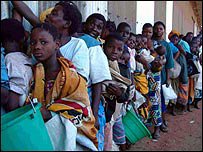
(BBC image) In Africa people in Malawi face a maize crisis. Quoting,

The worse harvest in a decade and failed rains are being blamed for what aid agencies warn is a rapidly emerging food crisis. What is making matters worse is HIV/Aids. One in seven people in Malawi is affected and it is fueling the problem of extreme hunger. Money that households would normally spend on buying seed and fertiliser, is being spent on transporting the sick to hospital and buying basic medicine instead.

In Zimbabwe even their own soldiers are hungry enough that there are shortages of food in the barracks and forced leaves. High food prices are a factor in Niger's hunger problems, because of the high demand for food in the surrounding countries. The crisis of African hunger was debated in this BBC feature; some of the discussion comments were excellent. Millions are at risk in Africa, but so are millions in southern Asia.

Earthquake survivors face winter hunger in the Kashmir area. It is a major crisis for the millions left homeless by the quakes in Pakistan, Kashmir and India. The article states, "As of 16 October, food had reached 440,000 people but an estimated 560,000 remained in "desperate need of assistance".

In our own hemisphere hunger is a major problem in several contries. The BBC reports that Guatemalans face hunger as a result of the recent natural disaster, Hurricane Stan. Rats ate the crops of many people in Nicaragua, one of the poorest nations in the Central America. The BBC article headlines, "The UN is to send 230 tons of emergency food aid to thousands of Miskito Indians facing hunger in Nicaragua."

Here at home, the Food Research and Action Center is an excellent site for exploring hunger in the United States. America's Second Harvest, the nation's food bank network, has excellent material on hunger in the U. S. The Children's Defense Fund explores the question of U.S. children's hunger in this 6-page PDF document. Here is what the USDA site has to say about "food security" in the U.S.:


Eighty-eight percent of American households were food secure throughout the entire year 2004, meaning that they had access, at all times, to enough food for an active, healthy life for all household members. The remaining households were food insecure at least some time during that year. The prevalence of food insecurity was 11.9 percent in 2004, up from 11.2 percent in 2003. The prevalence of food insecurity with hunger was 3.9 percent in 2004, up from 3.5 percent in 2003.

Since our population was 290,342,554 in July of 2003, the "3.9% of food insecurity with hunger" translates into 11, 323,360 hungry people in the United States. Is there anything that can be done about the recent increase in hunger? The above paragraph on hunger in America includes several references in the linked articles to organizations that endeavor to feed people who go to bed hungry. In your own city, there is probably a food bank, a soup kitchen or a homeless shelter that could use some help, either volunteering or donating. And many churches, synagogues and mosques as well as other faith based organizations focus of food pantries or feeding programs.

World wide, diminishing poverty and the predominance of violence and war will help. Improvements in agriculture are key to the long term solution. For example, unraveling the DNA code of the rice genome may be an answer for many countries where rice is the predominant staple.

Reference: Wikipedia's excellent section on hunger discusses many aspects of the problem and includes links to many organizations that work on hunger.


Technorati tags:

My topical post today at South by Southwest and The Reaction is about politics.

Friday, May 09, 2008

November's Child


Child Poverty in United States -- (November 2007 Report) "Who are America's Poor Children?" To quote NCCP:

. . . How many children in America are officially poor? Rates of official child poverty vary tremendously across the states.

Child poverty rates across the states, 2006

Figure 1: Child poverty rates across the states, 2006
[map: National Center for Children in Poverty]

* Nationwide, 17% of children live in families that are officially considered poor (13 million children).
* Across the states, child poverty rates range from 6% in New Hampshire to 29% in Mississippi.

Nearly 13 million American children live in families with incomes below the federal poverty level, which is $20,650 a year for a family of four. The number of children living in poverty increased by 11 percent between 2000 and 2006. There are 1.2 million more children living in poverty today than in 2000.

Not only are these numbers troubling, the official poverty measure tells only part of the story—it is widely viewed as a flawed metric of economic hardship (see box). Research consistently shows that, on average, families need an income of about twice the federal poverty level to make ends meet. Children living in families with incomes below this level—for 2006, about $41,000 for a family of four—are referred to as low income. Thirty-nine percent of the nation’s children—more than 28 million in 2006—live in low-income families.

Child poverty in Canada -- (November 26, 2007): "Child poverty rates unchanged in nearly 2 decades: report." To quote CBC News:

The rate of child poverty in Canada is the same as it was in 1989, despite numerous attempts by the federal government to tackle the issue, an advocacy group reported Monday.

. . . The report says that, in 1989, the House of Commons unanimously voted to end child poverty. Eighteen years later, despite a 50 per cent increase in the size of the economy, the child poverty rate remains unchanged at 11.7 per cent, according to the report.

One in eight children in Canada — about 788,000 — live in poverty when income is measured after taxes, the report says, citing Statistics Canada data. When income was measured before taxes, the number rose to one in six children.

Child Poverty in United States -- Over Time: (November 1995 Report). To quote the National Research Council, Board on Children and Families:

  • Poverty among U.S. children reached its highest level in 30 years in 1993. Cansus data for 1994 shows that 15.7 million children, or 22.7 percent, were classified as poor.

  • Children in families continuously on welfare from 1986 to 1990 were 1.6 times more likely to have significant behavioral problems than those never on welfare or poor. Children in families that left the welfare system but remained poor also were likely to have behavioral problems.

  • Home environments of children whose families stopped receiving welfare but remained poor did not differ significantly from those families still on welfare.

  • Inflexible hours at child care centers frequently caused problems for working parents with low incomes, nonstandard working hours or more than one job.
From an earlier post I conclude with this beloved nursery rhyme --

Monday's Child

Author: Unknown

Monday's child is fair of face,
Tuesday's child is full of grace,
Wednesday's child is full of woe,
Thursday's child has far to go,
Friday's child is loving and giving,
Saturday's child must work for a living,
But the child that's born on the Sabbath day,
Is fair and wise and good and gay.

My topical post today at South by Southwest and The Reaction is about politics.

Technorati tags:

Sunday, May 04, 2008

References on Spirituality


Today's post is a reading list of books in my library on the general subject of spirituality, mental peace, stress management, and questions related to existential philosophy. Enjoy!

"A Return To Love: Reflections On the Principles Of a Course In Miracles" By Marianne Williamson. Harper Collins, 1992

"A World Waiting To Be Born: Civility Rediscovered" by M. Scott Peck. Simon and Schuster, 1993

"Chicken Soup For the Unsinkable Soul" by Canfield, Hansen and McNamara. Health Communications, 1999

"Compassion in Action: Setting Out On the Path of Service" by Ram Dass and Mirabai Bush. Bell Tower Pub., 1992

"Creative Visualization" by Shakti Gawain. MIF Books, 1978

"Finding Values That Work: The Search For Fulfillment" by Brian O'Connell. Walker & Co., 1978

"Fire in the Soul" by Joan Borysenko. Warner Books, 1993

"Further Along the Road Less Traveled" by M. Scott Peck. Simon and Schuster, 1993

"Guilt is the Teacher, Love is the Lesson" by Joan Borysenko. Warner Books, 1990

"Inner Simplicity: 100 Ways To Regain Peace and Nourish the Soul" by Elaine St. James. Hyperion, 1995

"Insearch:Psychology and Religion" by James Hillman. Spring Pub. 1994

"Man's Search for Himself" by Rollo May. Signet Books, 1953

"Mythologies" by William Butler Yeats. Macmillan, 1959

"Myths, Dreams and Religion" by Joseph Campbell. Spring Pub. 1988

"Passion for Life: Psychology and the Human Spirit" by John and Muriel James. Penguin Books, 1991

"Peace Is Every Step" by Thich Nhat Hahn. Bantam Books , 1991

"The Heroine's Journey" by Mureen Murdock. Random House, 1990

"The Hope For Healing Human Evil" by M. Scott Peck. Simon and Schuster, 1983

"The House of Belonging" poems by David Whyte. Many Rivers Press, 2004

"The Road Less Traveled: A New Psychology of Love, Traditional Values and Spiritual Growth" by M.Scott Peck. Simon and Schuster, 1978

"The Soul's Code: In Search of Character and Calling" by James Hillman. Random House, 1996

"The World Treasury of Modern Religious Thought" by Jaroslav Pelikan. Little, Brown & Co., 1990

"Unconditional Life" by Deepak Chopra. Bantam Books, 1992

"Wherever You Go There You Are: Mindfulness Meditation" by Jon Kabat-Zinn. Hyperion, 1994

"Zen Keys: A Guide to Zen Practice" by Thich Nhat Hahn. Doubleday Dell Pub. 1974


Note: This list is displayed permanently in the left column of Making Good Mondays.


My topical post today at South by Southwest and The Reaction is about Russia.
Technorati tags:

Sunday, January 06, 2008

Eye Candy: slide shows

(Yum Yum image from FreeFoto.com)

Innovation abounds in the blogosphere. The World Wide no longer consists of mere words. The amount of band width now available to most of us makes the Internet rich with imagery. I call it "eye candy."

I do so because of my early experiences with a good 35mm camera. I bought it in the 1970's just before I took two semesters of college photography classes. I had everything eventually. . . a bunch of different focal length lenses, a variety of filters, a good flash unit, a light box, a viewing lupe, a tripod, a slide projector and portable screen and a darkroom. And I produced a fairly good number of slide shows, beginning with one I did as a class project. I found a mail-in photo processing place on the west coast that would send me a free 36 exposure roll of 35mm film, a set of mounted slides and a roll of negatives with each order. I was in heaven. I used that service for years. They are now out of business, another casualty of the digital age.

Slides -- I have a trunk full of old 35mm slides that I hope to scan and store digitally some day. (Another of my oft repeated New Year's resolutions). Do you know what I mean by the photographic term, slides? Philip Guo explained it well in "Integrity in Digital Photography:" To quote:

Slide, Film, and Digital Photography

What does a photograph truly look like after you have taken it?

In traditional slide photography, the slide that results from the development process is your final photograph. Take it or leave it. That's it. That is why professionals love to use slides. There is a certain satisfaction in knowing that if your picture looks good when it is projected onto the wall, then you did everything perfectly - you chose the correct film, you set the right f-stop and shutter speed, and you composed the shot optimally. However, if the picture is a bit darker or lighter than you intended, but you like everything else about it, then you're flat out of luck. There ain't nothing you can do. Slide photography is costly (and thus mostly reserved for pros) because there is no forgiveness for even minor mistakes.

Film photography is a bit more forgiving since photographs are developed into negatives before being printed onto photo paper. Through proper darkroom techniques, a photographer can control the brightness, contrast, and color balance of a photograph. He can even make specific changes to certain areas of a photograph in a process known as dodging and burning. The great landscape photographer Ansel Adams is well-known for his remarkable ability to dodge and burn photos in the darkroom. However, most people do not have the time nor skill to custom process every photo in the darkroom. We take our film to photo labs where a computer decides what the best darkroom processing settings are for our photographs. A picture that is a bit darker or lighter than intended can be fixed in the darkroom to a certain extent. As a result, just because a photograph looks great as a print does not mean that you did everything perfectly. The photo lab computer probably fixed some of your minor mistakes to give you a good-looking print.

All of the photos on the Internet are in digital format, and many of them were originally taken as slide or film photographs. They were scanned in using either a conventional flatbed scanner or using a more expensive (but higher-quality) film scanner that scans negatives instead of prints.

Google hosts all but one of my blog websites. The photos or clipart that I use to illustrate my blog posts at South by Southwest and at this blog, Making Good Mondays, were all stored on Picasa Web Albums, Google's great feature. It is where I have made all my Internet slide shows available to the public. I have also added or embedded several "slide shows" on the pages of my blogs. Here's a list:

South by Southwest slide shows --

  • "john & karen hollingsworth wildlife photos" is a series of lovely nature photos for the National Wildlife Refuge System. It is located about midway in the right sidebar column.

  • "millennium slide show" is political commentary about the Bush administration. It has captions, and is located at the bottom left of the page.

Making Good Mondays slide shows --

  • "Life is Good" is my little photo montage celebrating life. It leads the left column.

  • "Spacey Shots" is another captioned photo essay recognizing my "space junky" side. It is also at the bottom right of my posting section.

The end of this story illustrates why slide shows have such a warm place in my heart. That first slide show I produced back in the mid-1970's eventually let me into my late-blooming career as a Social Worker. Though I eventually landed in my counseling office after reaching the age of 50, I never lost my love for imagery. And here I am again 30 years later doing slide shows, but in a much more magical way.

My New Year's resolution is to scan my old slides, and only then buy myself a digital camera for being such a good girl.

Cross-posted at Southwest Blogger

My topical post today at South by Southwest and The Reaction is about a war casualty.

Technorati tags:

Wednesday, January 02, 2008

All about rocks

Today's post is another in my series of "All About _______"
Others include:
There is an old saying that "a rolling stone gathers no moss." It seems to fit with the "fresh start" approach many people take with New Year's resolutions. Moss might to grow on you if you sit still too long. So I'm going to get up and do something for myself as this new year begins. I am beginning with the message to myself, "Lighten up!"

In a lighter moment not long ago I came across this: "Smile vs Frown: How NOT to be a walking accident" - from a quirky and interesting little website called Happy Brainstorming. I bring this up because one of my resolutions is to find more to smile about in 2008. There are two reasons. I will sleep better, and I will put fewer wrinkles on this elder face. To quote from the website:
It is well known that non verbal communication is very important, as it judges your likeability. But it seems that the most important of all signals pass THROUGH facial expressions. The facial expressions are much more important than any other body language posture.
Rolling Rock is the name of a beer. I can't drink alcohol any more because of the medications I take, which is a little sad. A number of their TV commercials crossed over the edge enough to offend a few people and were banned. Rolling Rock has a website that requires you to be at least 21 years of age. I am old enough to go through its "Age Gate", but I won't. But I will say that there's nothing like a cold Tecate beer with a Texas barbecue sandwich on a hot summer day!

I collect rocks -- all kinds of rocks. Rocks are heavy. Though not the best thing to take on an airplane in large numbers, rocks make wonderful trip souvenirs. I have tumbled river rocks from high mountain streams in Colorado and Wyoming. I have a chunk of pink granite from a road work site where my brother worked. I have a plate of small polished rocks with a beautiful candle in the middle. I have a collection of beautiful fossils under the glass top of our coffee table. I have a big shell fossil as a doorstop for my front door. Our Texas Sage is in a bed that has a base of round river rocks. We collected flagstones from the building site of our current house, making them into flagstone walks to our tiny back yard. That was the year I learned to "tuck-point" concrete. Ah, those were the days!

Happy New Year, everybody!

Cross-posted at Southwest Blogger

My topical post today at South by Southwest and The Reaction is about civil liberties.

Technorati tags:

Thursday, November 29, 2007

All about frogs

For your Thursday enjoyment, boys and girls, "All about frogs" should begin with what Wikipedia says about this strange and abundant creature. The illustration of this post came to me in one of those ubiquitous forwarded e-mails from a friend. As with all such fun photos, the origins of it are lost in the mists of cyber time, so giving proper credit is not possible.

Girls, did you marry a prince or a frog? It also impossible to remember when I first learned that princes can turn into frogs. The question first came up for me as a child when my mother read me this wonderful fairy tale: " The Frog Prince " Classic Fairy Tale, Illustrated by Gustaf Tenggren. The reality is, I have been married to a prince for over 50 years.

To me Kermit, The Frog was always a real person, most closely associated with his friend Jim Hensen until Hensen's death in 1990. He is also associated with fellow Muppet, Miss Piggie. I never exactly understood their relationship but it is quite adorably memorable. Kermit's 50th Anniversary year was in 2005.

Frogs must have good love lives. When I was raising our children I loved to hear Tennessee Ernie Ford sing"Froggy Went a Courtin ' ." It was also recorded by, of all people, folk singer Bob Dylan. It has 19 verses, beginning with this familiar one:
1. Frog went a-courtin', and he did ride, Uh-huh,
Frog went a-courtin', and he did ride, Uh-huh,
Frog went a-courtin', and he did ride.
With a sword and a pistol by his side, Uh-huh.

Frogs and people; do frogs cause warts? My brother was great at catching frogs. He thought I would like to hold them, too, but I didn't want to at all because I was worried about this common myth. Dr. Shmerling, writing for InteliHealth, says no to the warts question. He also lists related medical myths, which include:
  • The ability to cause or cure hallucinations
  • The ability to detect poison
  • The ability to improve fertility

All about frogs -- Did you know that frogs set up their own website over ten years ago? In conclusion this post should end in the spirit which it began, with "Weird Frog Facts."

Cross-posted at Southwest Blogger .

My topical post today at South by Southwest and The Reaction is about "Arrested Developments."

Technorati tags:

Wednesday, November 28, 2007

The rhyme that wrote itself

The rhyme that wrote itself
"They Called Her the Lady" was its name.
Full blown in my sorrow new thoughts came.
My first poem. Its writing helps to proclaim
The rage we now feel.
"She was the lady," a scared witness proclaimed.
"They called her the lady" was the new frame
To contain all the words that now inflame
My new poet's feelings.
The courtroom was stuffy and filled end to end.
We're at the trial, feeling we have to attend.
Their kin and buddies, and her very dear friends
Who still feel it's so very unreal.
This lady, this woman, this friend of ours,
Was senselessly murdered. It was after-hours.
For her purse alone, the coward over-powered
Her as she sat at the wheel.
How could Linda's life -- her name I reclaim --
Have been taken by the small bullet that maimed?
Royalty she was not, nor was her good heart's fame
Widespread. Our mentor, she was ideal.

The rhyme that wrote itself, the healing flame,
Seared over my sorrow. After years I've reclaimed
My peace with it. After death it is never the same;
Know the poet's pen can help to heal.

Copyright by Carol Gee, November 28, 2007

Cross-posted at Southwest Blogger
My topical post today is at South by Southwest and The Reaction .
Technorati tags:

Monday, November 05, 2007

The bridge is too far

A Bridge Too Far

I want to reach out my hand in peace to you.
But first what I really want is evidence, proof
Of your intentions.

The reach is so far. Neither of us has a clue.
The first to extend a hand is at risk, spoofed
Would make dissension.

The bridge span is far; I don't know the how-to.
The first should be you so don't be aloof.
I've measured dimensions.

I want to trust my reach but, afraid you'd outdo,
I first need to know there's no way I can goof.
I have all this tension.

To cross this bridge might mean a new view.
I'll first have to let go old beliefs, off a roof
Without suspension.

Now trust me when I tell you what is true.
You first. From there to here is foolproof.
Thanks -- Don't mention it.


Copyright by
Carol Gee
November 5, 2001

Cross-posted at Southwest Blogger
My topical post today at South by Southwest and The Reaction contrasts wars and space exploration.
Technorati tags:

Thursday, October 25, 2007

250 on Fish

What are the best "250 words on fish?"
That is the assignment, today, boys and girls. Remember your Five "W's" and the KISS rule.
You don't remember? Well, I'll give them to you again. In any expository writing (I'll explain "expository" in a minute), answer Who? What? When? Where? and Why? Expository is explaining something.

KISS is "Keep it simple, Stupid," but it's not nice to call someone stupid, so I won't. Keep it simple, Sweetheart.

So far we haven't said a word about fish. We have said 88 words about everything BUT fish.
So let's get to it -- 161 words about fish:

A "fish," according to Webster's Dictionary, is to quote:
(a) an aquatic animal or (b) any of numerous cold-blooded strictly aquatic craniate vertebrates that have typically an elongated somewhat spindle-shaped body terminating in a broad caudal fin, limbs in the form of fins when present at all, and a 2-chambered heart by which blood is sent through thoracic gills to be oxygenated.
-- 160 now -- and I haven't really told you what I , myself think of fish. I will soon be over and out of words. So I had really better get to it now.

The thing about it is you may not care a WHIT about WHAT I think of fish. I'd bet money on that. I give you what I KNOW about fish.
  • I know it has always made me sad whenever a pet fish in my care has died.
  • I know I won't ever catch one, because I can't do worms.

Cross-posted at Southwest Blogger
My topical post today at South by Southwest and The Reaction is about the Secretary of State.
Technorati tags:

Monday, August 06, 2007

Broken Boundaries

(credit: Zack Carter)


Fence Mending


When we have broken boundaries,
Mixed messages are too easy to send.
When we invade each other's space
Our comfort levels get all up-ended.
With broken boundaries I invade your turf.
It's then and there that I learn that I offend.
And when you cross over into mine,
It takes courage for me to recommend
"You stop right there. You are out of bounds," I say.
We cannot pretend it is all OK.


It is important for us both to know
Where you and I begin and end.
I begin and end with my own "stuff."
When this is clear, I truly comprehend
That my internal space belongs to me
And yours belongs to you, my friend.
Therefore, for offending we must make amends.
Our task is to repair those boundaries without delay.
Or hurt feelings, held grudges will not go away.

Copyright - Carol Gee
(8/6/08)

Cross-posted at Southwest Blogger
My topical post today at South by Southwest and The Reaction is about politics.

Technorati tags:

Wednesday, July 25, 2007

Hot Nights

Myth is the public dream, and dream is the private myth. - Joseph Campbell

Hot Nights

Warm nights keep us up - we enjoy the balmy air.
Hot nights keep up up - we are never prepared
to sweat while sleeping. Before we never cared.
That's when the power was on. Then we fared
Better while sleeping. Before the war, unaware,
Warm nights were quite OK. And hot nights, fair.

Hot nights keep us up - we must retreat to roofs
To sleep. We are not prepared, not bulletproof.
We'd sweat out life up there - we might go poof.
When the power is on our sleeptime's foolproof.
Now's the war. Some souls sleep eternally, aloof
to hot, warm, or cool, unaware and weatherproof.

copyright 2007 by Carol Gee
Cross-posted at Southwest Blogger.
My topical post today at South by Southwest and The Reaction is about the color of advocacy.
Technorati tags:

Monday, July 09, 2007

And a child shall lead them


"I dream of peace," said the child.
Would we could - dream awhile,
We who are growing could smile,
At the idea of the dream of peace.


"I dream of peace," said the elder.
The dream's been lost in the blur
Of an unjust war by sly amateurs.
We long for a conversion to peace.


"I dream of peace," said the general.
Warrior in the cause of justice for all,
He sees through the ploy, "no withdrawal!"
Diplomacy's better for the real peace cause.


"We dream of peace," said the children
Of the hot dusty streets. Bewildered,
They ask for quiet, for food, for filial
Joining between tribal elders in peace.


Copyright by Carol Gee - 7/9/07

Myth is the public dream, and dream is the private myth. - Joseph Campbell

Saturday, June 30, 2007

To: "Too Many"

    To: "too many" -

Women with a dreaded diagnosis, the numbers are far

Too many.  Suspected breast cancer they learn.

It’s like an epidemic my mom says - a hero, she’s the star

Survivor, the toughest of surgeries. Now it’s my turn

To take on my own fight against cancer.


The number of new patients in Doc's office was abnormal.

 Too many large envelopes with mottled imagery.

 Faces taut and determined to behave as if all’s normal.

Will surgery be recommended? Their heads swimming,

As mine did too.  I join new patients, now on the schedule

With their own fights against cancer.


The bench in the room with the small round table held

Too many of the stuffed heart-shaped pillows. 

Volunteer-stitched of comfy print, filling the space well.

For many surgeries’ sore under-arms, I’m willing

 To take mine home, too.  I join all the others who fell

Victim to cancer.


But I will not be its Victim.  “No despair nor self pity;” I tell

It to many.  And I’ll not stuff my fears, my feelings.

The “Breast Care Center’s” warm atmosphere’s gelled

Into a safe place for my breast’s surgical healings.

I’m one of “us” now. I join all the women who celebrate

An early diagnosis of cancer!


By Carol Gee

June 21, 2007

AddThis

Bookmark and Share

References on Spirituality -- Favorites from my old collection

  • "A Return To Love: Reflections On the Principles Of a Course In Miracles" by Marianne Williamson. Harper Collins, 1992
  • "A World Waiting To Be Born: Civility Rediscovered" by M. Scott Peck. Simon and Schuster, 1993
  • "Chicken Soup For the Unsinkable Soul" by Canfield, Hansen and McNamara. Health Communications, 1999
  • "Compassion in Action: Setting Out On the Path of Service" by Ram Dass and Mirabai Bush. Bell Tower Pub., 1992
  • "Creative Visualization" by Shakti Gawain. MIF Books, 1978
  • "Finding Values That Work: The Search For Fulfillment" by Brian O'Connell. Walker & Co., 1978
  • "Fire in the Soul" by Joan Borysenko. Warner Books, 1993
  • "Further Along the Road Less Traveled" by M. Scott Peck. Simon and Schuster, 1993
  • "Guilt Is the Teacher, Love Is the Lesson" by Joan Borysenko. Warner Books, 1990
  • "Inner Simplicity: 100 Ways To Regain Peace and Nourish the Soul" by Elaine St. James. Hyperion, 1995
  • "Insearch:Psychology and Religion" by James Hillman. Spring Pub. 1994
  • "Man's Search For Himself" by Rollo May. Signet Books, 1953
  • "Mythologies" by William Butler Yeats. Macmillan, 1959
  • "Myths, Dreams and Religion" by Joseph Campbell. Spring Pub. 1988
  • "Passion for Life: Psychology and the Human Spirit" by John and Muriel James. Penguin Books, 1991
  • "Peace Is Every Step" by Thich Nhat Hahn. Bantam Books , 1991
  • "The Heroine's Journey" by Mureen Murdock. Random House, 1990
  • "The Hope For Healing Human Evil" by M. Scott Peck. Simon and Schuster, 1983
  • "The House of Belonging" poems by David Whyte. Many Rivers Press, 2004
  • "The Road Less Traveled: A New Psychology of Love, Traditional Values and Spiritual Growth" by M.Scott Peck. Simon and Schuster, 1978
  • "The Soul's Code: In Search Of Character and Calling" by James Hillman. Random House, 1996
  • "The World Treasury of Modern Religious Thought" by Jaroslav Pelikan. Little, Brown & Co., 1990
  • "Unconditional Life" by Deepak Chopra. Bantam Books, 1992
  • "Wherever You Go There You Are: Mindfulness Meditation" by Jon Kabat-Zinn. Hyperion, 1994
  • "Zen Keys: A Guide to Zen Practice" by Thich Nhat Hahn. Doubleday Dell Pub. Group, 1974

About Me

My photo
A retired counselor, I am equal parts Techie and Artist. I am a Democrat who came to the Southwest to attend college. I married, had kids and have lived here all my adult life.